-
JD Spinoza
JD Spinoza
JD enjoys teaching people how to use ZoomShift to save time spent on scheduling. He’s curious, likes learning new things everyday and playing the guitar (although it’s a work in progress).
- Mar 15, 2026
Predictive Scheduling Laws by State: The 2026 Complete Guide
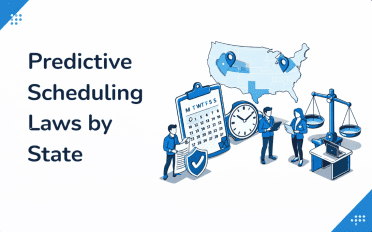
If you are an employer in an industry with a high percentage of hourly workers, your business is likely affected by predictive scheduling laws.
Read on to learn where predictive scheduling laws are in effect in the US and what they mean for your jurisdiction.
What Are Predictive Scheduling Laws in the US?
Predictive scheduling laws, also known as Fair Workweek laws, are a set of rules governing how employers schedule their hourly workers.
These laws were created to protect workers from unpredictable scheduling practices and ensure they are provided with reasonable notice of when they are required to work.
The specifics of the laws vary depending on the jurisdiction. However, the main benefits for workers under most predictive scheduling laws are:
- Advance schedule notice (typically 7-14 days)
- Compensation for late changes
- Good-faith hour estimates
- Mandatory minimum rest between shifts
These rules apply most commonly to industries that have large hourly workforces, like retail, hospitality, and food service. Since these industries often experience unpredictable scheduling, they come under greater scrutiny under these laws.
Predictive Scheduling Laws by Jurisdiction
The United States does not currently have a federal predictive scheduling law. These rules are set by individual states and cities, and each jurisdiction defines its own coverage thresholds, notice periods, and penalties. Here’s a look at how the law applies in seven different jurisdictions:
1. Oregon
The only state in America that has enacted a predictive scheduling law is Oregon. Called the Oregon Predictive Scheduling Law, it applies to businesses with 500+ employees worldwide that operate in retail, hospitality, or food service industries.
This law states that employers in Oregon must:
- Post written work schedules at least 14 days in advance.
- Provide additional pay if there are any changes made after the posting.
- Pay one extra hour at the regular rate if hours are added, increased by more than 30 minutes, or hours are changed and not reduced.
- Pay half the regular rate if hours are reduced or cancelled.
- Provide employees with ten hours of rest between shifts, unless they choose to work sooner, in which case they earn time and a half.
2. NYC
New York City’s Fair Workweek Law regulates scheduling practices for retail and fast food businesses.
The regulations differ between the two industries. For retail businesses, if you have at least 20 employees in New York City and if you sell mainly consumer goods, then the law applies.
The main scheduling rules are:
- Written work schedules must be provided at least 72 hours in advance.
- Shifts cannot be cancelled if initiated within 72 hours of the start time.
- Employee consent must be taken in order to add a new shift within 72 hours.
- On-call scheduling, in which employees are required to be available without a confirmed shift, cannot be implemented.
The law also requires employers to update and repost schedules in the event of changes and does not permit retaliation against employees seeking or accessing these rights.
3. Chicago
Chicago’s Fair Workweek Ordinance applies to employees in seven industries:
- Building services
- Healthcare
- Hotels
- Manufacturing
- Restaurant
- Retail
- Warehouse services
Employees in these industries are subject to the law if they earn an hourly wage of $32.60 or less and work for an employer with at least 100 employees globally. For restaurants, the threshold is 250 employees in at least 30 locations.
Employees in these industries have the following rights:
- Advance schedule notice is needed 14 days prior.
- If the schedule is changed after a shift is posted, employees receive one hour of additional pay.
- Workers retain the right to decline added hours (if assigned after the original schedule is already posted).
- Mandatory rest period between shifts of at least ten hours.
4. Philadelphia
Philadelphia’s Fair Workweek Law (in effect since April 2020) applies to the retail, hospitality, and food service industries.
The law typically applies to employers with 250 or more employees worldwide and at least 30 locations globally. The scheduling protections include:
Advance schedule notice at least 14 days prior.
- Additional compensation is applicable if the employer changes a posted schedule.
- Adding hours, moving a shift, or changing work location requires one hour of additional pay.
- If hours are cut or a shift is cancelled, employers must ½ pay for the hours not worked.
These rules generally apply when the change is initiated by the employer or manager. There are some exceptions allowed for situations where employees request changes or shift swaps, or in cases of emergencies.
5. San Francisco
San Francisco regulates scheduling through the Formula Retail Employee Rights Ordinance (FRERO). The law applies to formula retail businesses with at least 40 locations worldwide and 20 or more employees in San Francisco, as well as their janitorial and security contractors.
If you’re covered under FRERO, you must give workers these scheduling protections:
- Advance schedule notice required 14 days prior.
- Schedule changes with less than seven days’ notice require 1-4 hours of additional pay.
- Employees required to be on-call but not called in receive 2-4 hours of regular pay.
- New hires receive a “good faith” estimate of expected shifts and working hours.
- Additional hours are offered to current part-time employees before hiring new staff or contractors.
6. Seattle
Seattle Secure Scheduling Ordinance (in effect since 2017) regulates scheduling for large retail and food service employers.
The law applies to businesses with 500 or more employees worldwide. Full-service restaurants are covered if they operate in at least 40 global locations.
Key scheduling protections are:
Advance work schedule notice posted 14 days prior.
- “Good-faith” hourly estimates for new hires.
- One additional hour of pay for added or changed shifts.
- Reduced or cancelled hours need payment for half of the scheduled hours.
- Employees working shifts less than ten hours apart must receive time-and-a-half pay.
The ordinance also requires employers to offer additional hours to current employees before hiring new staff. To stay compliant with this law, you must also maintain scheduling records for up to three years.
How ZoomShift Helps You Stay Compliant
Scheduling laws regulate how schedules are created, but they also require employers to keep records showing their compliance. This means you need to document things like:
- When work schedules are published
- Changes made after posting
- When employees were notified about changes
- Employee consent for added or modified shifts
This is where ZoomShift becomes helpful. ZoomShift allows managers to publish schedules digitally, update shifts quickly, and notify employees through text, email, or mobile notifications.
Because schedule updates are logged automatically, businesses have a clear change history showing when they were posted or edited.
This is a kind of built-in documentation to help you stay compliant with fair work week laws, and also have a record on hand if compliance issues arise later. Take a free trial today.
JD enjoys teaching people how to use ZoomShift to save time spent on scheduling. He’s curious, likes learning new things everyday and playing the guitar (although it’s a work in progress).